Bundles vs Single Products: What actually makes more money
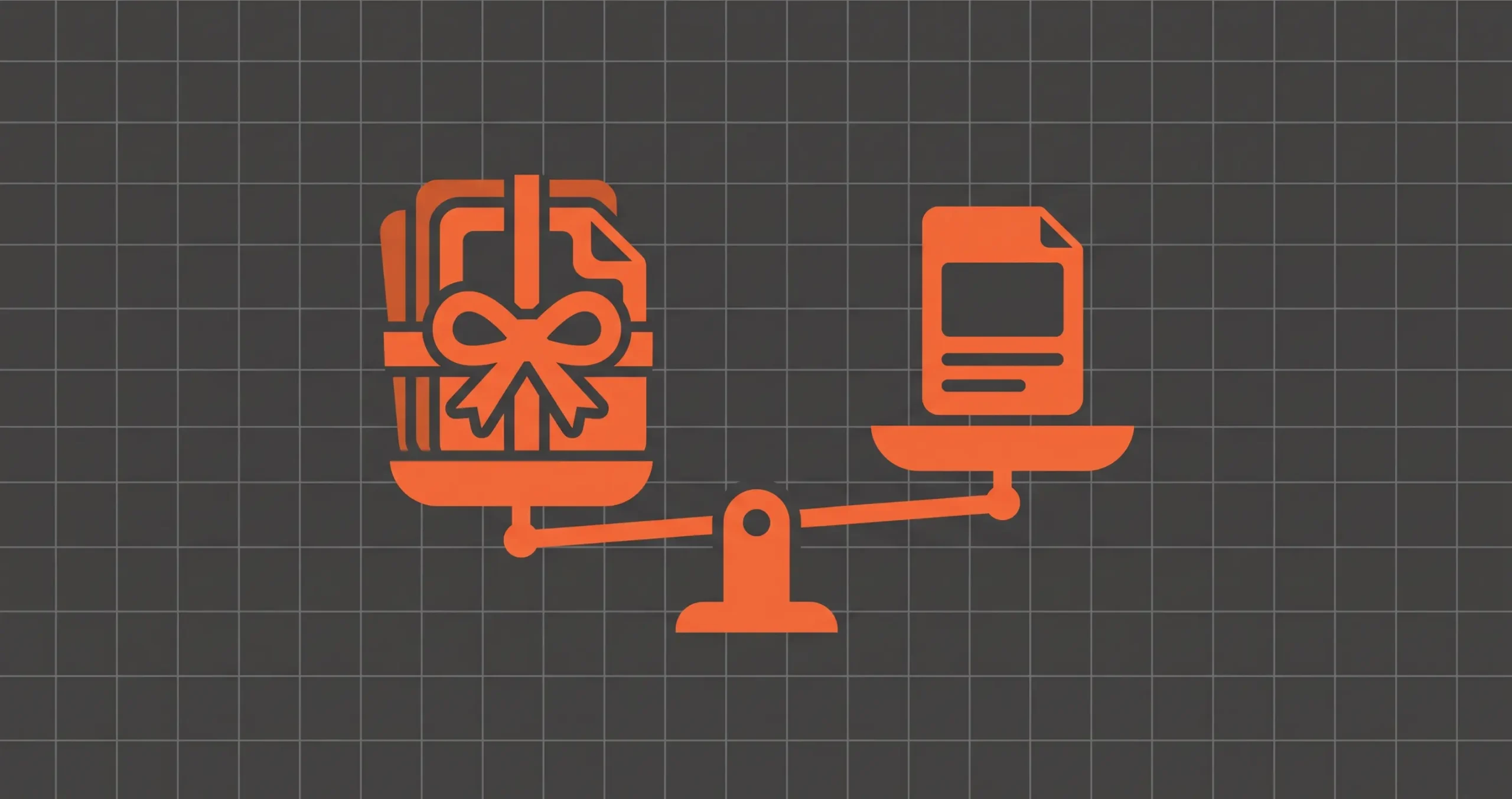
For digital products, the setup that usually earns the most is a bundle sold next to the single items, so the buyer can pick either.
Economists call this mixed bundling. Selling only singles leaves money on the table, and so does selling only bundles. A badly built bundle can even earn less than the singles it replaced.
That last point is where most sellers go wrong, so most of this article is about it.
Run your own prices through the Etsy fees calculator to see what a single and a bundle each leave you after fees.
Key takeaways
- A bundle sold alongside the single items beats a bundle-only shop and a singles-only shop in most of the research on this question.
- Bundles work because buyers value each item differently, and one combined price catches more of them than separate prices can.
- Filler hurts. Buyers judge a bundle by the average quality of what’s inside, so weak extras pull the whole bundle’s value down.
- On marketplaces with fixed per-order fees, cheap singles lose a far bigger share of each sale to fees than a bundle does.
- Keep your singles listed even after you launch the bundle. Each single is another way for a buyer to find you in search.
Why mixed bundling wins
Mixed bundling wins because it sorts your buyers into groups without asking them anything. The buyers who want everything at a discount take the bundle. The buyers who want one specific thing pay full price for that one thing.
The clearest evidence comes from video games. Timothy Derdenger and Vineet Kumar studied Nintendo console and game bundles and found that mixed bundling beat both pure bundling and selling only separate components, on hardware and software revenue alike.
In a Harvard Business School write-up of the study, Kumar explained that price-sensitive buyers chose the bundle, which separated them from buyers willing to pay more for the console alone.
He also stressed that bundles tended to work only when the same products could still be bought separately.
Consoles aren’t PDFs, of course. But the same split shows up in any shop with a mix of bargain hunters and buyers who know exactly what they want.
The math, with three buyers
A short example shows where the extra money comes from. It uses made-up buyers and prices, so treat it as a model and nothing more.
You sell two digital products: a budget planner and a debt payoff tracker. Three buyers visit your shop.
- Buyer A would pay $8 for the planner and $3 for the tracker.
- Buyer B would pay $3 for the planner and $8 for the tracker.
- Buyer C would pay $8 for the planner and nothing for the tracker.
Now run the three strategies.
Singles only, both at $8. Each buyer takes the one item they value at $8. Revenue: $24. Drop the price to $3 and A and B buy both, C buys one, and you make $15. The $8 price is the better of the two.
Bundle only, at $10. A and B each value the pair at $11, so they buy. C values the pair at $8, so C leaves. Revenue: $20. Cut the bundle to $8 to catch C and you make $24, the same as singles.
Mixed, with singles at $8 and the bundle at $10. A and B take the bundle. C buys the planner alone. Revenue: $28.
That $4 gap is the whole argument for mixed bundling. The bundle captures buyers whose interest is spread across items. The single captures the buyer with one strong need, at full price. Neither strategy alone gets both.
Why bundles suit digital products in particular
Digital products cost almost nothing to deliver, which removes the main risk of bundling. If a buyer never opens three of the eight files in your bundle, you lost nothing producing them.
Yannis Bakos and Erik Brynjolfsson showed this formally in their work on bundling information goods.
Their key finding: a buyer’s interest in one item is hard to predict, but their total interest in a large bundle is much easier to predict, because the highs and lows average out.
That predictability lets a seller set one bundle price that more buyers accept. The authors note their main results don’t carry over to most physical goods, because the cost of making items the buyer never uses eats the gain.
Bakos and Brynjolfsson also found bundling works best when buyers value the individual items at roughly similar levels. That detail matters a lot for the next section.
When a bundle makes less money
A bundle loses money when it lowers the value buyers see in it. That happens in three common ways.
Filler drags the whole bundle down
Buyers average a bundle’s contents. They don’t add them up. Kimberlee Weaver, Stephen Garcia and Norbert Schwarz called this the presenter’s paradox, and found it in tests ranging from music bundles to gifts.
Sellers assume more items means more value. Buyers judge the overall package, and a few mildly useful extras dilute the strong ones.
For a template shop this has a direct consequence. Eight strong templates usually make a better bundle than eight strong ones plus twelve throwaway pages added to hit a round number. Bundle sizes like 50+ templates often signal filler to the buyer, even when the core is good.
Cheap add-ons make the add-on look cheap
A heavily discounted add-on can cut the perceived value of that item for good.
Mauricio Palmeira and Joydeep Srivastava studied add-on offers (buy one product, get a second for a low extra price) and found that a low add-on price reduced how much people valued the add-on, with the effect lasting after the offer ended.
In practice: if your bundle prices each template at a few cents, buyers start treating those templates as a few-cents product. That makes your $5 single harder to sell afterward.
The bundle answers no single need
A bundle sells when one buyer, doing one job, would use most of what’s inside. A new landlord needs a lease checklist, a rent ledger and a move-out form.
A random mix of a wedding planner, a fitness log and a resignation letter has no buyer, so each item only appeals to a fraction of visitors and the averaging problem from above gets worse.
The same logic applies to your whole shop: see whether to sell different types of items in one Etsy shop.
Fees change the math on cheap singles
On marketplaces that charge fixed fees per item or per order, low-priced singles lose a large share of every sale. Etsy charges US sellers a $0.20 listing fee, a 6.5% transaction fee and 3% + $0.25 for payment processing.
Etsy changes these from time to time, so check the fee policy in Etsy’s Help Center, or plug your current prices into the Etsy fees calculator.
At those rates, the gap between a cheap single and a bundle is large:
| Sale | Price | Fees (approx.) | You keep | Share kept |
|---|---|---|---|---|
| One template | $2.00 | $0.64 | $1.36 | 68% |
| Five-template bundle | $8.00 | $1.21 | $6.79 | 85% |
| Ten-template bundle | $14.00 | $1.78 | $12.22 | 87% |
The method: $0.20 listing renewal, plus 6.5% of the price, plus 3% of the price, plus $0.25. Sales tax, currency conversion and Offsite Ads are left out, and Etsy Offsite Ads alone can add 12% to 15% on the orders they bring in.
So a seller pricing singles at $2 gives away about a third of each sale. Raising single prices fixes part of this. A bundle fixes more of it, because the fixed cents get spread across a bigger order.
How to decide what to bundle
Run each product idea through these questions in order.
- Does one of your items already sell well on its own? Keep it listed as a single at full price, and build a bundle around it with the items its buyers would need next.
- Would one buyer, for one job, use most of the items? If yes, bundle them. If the items serve different people, keep them apart.
- Is any item clearly weaker than the rest? Cut it. A smaller bundle of strong items beats a bigger one with filler.
- Are the items worth roughly the same to the buyer? If one item is worth far more than the others, sell it as the main product and offer the rest as an optional add-on. Hiding it inside a bundle undersells it.
- Is the bundle priced above your best single? It should cost clearly more than any one item, so buyers who only want one item still have a reason to buy the single.
A workable starting point for pricing: set the bundle somewhere between two and three times your single price, then list the combined single prices next to it so buyers see the saving. That range is a starting guess to test.
The research doesn’t give a number for it. Once you have a number, check it in the Etsy pricing calculator so the bundle still clears your fees.
Keep the singles even when the bundle sells
Removing singles once a bundle takes off cuts your visibility in search. Each single listing ranks for its own narrow search, such as a resignation letter template or a rent payment record.
A bundle listing ranks for broader terms and competes with far more sellers. More on how ranking works: the Etsy algorithm explained.
Buyers who land on a single listing can then see the bundle in your shop. That path, from a narrow search to a cheap single to a bundle upgrade, is how many small digital shops grow their average order. Your singles are the doors. The bundle is what’s inside.
How this was worked out
The core findings come from peer-reviewed research on bundling: the Derdenger and Kumar study of video game bundles, the Bakos and Brynjolfsson papers on bundling information goods, and the Weaver, Garcia and Schwarz presenter’s paradox studies.
The three-buyer example and the fee table are worked calculations with made-up prices.
The research covers consoles and lab experiments far more than small template shops, so treat the specific pricing suggestions as starting points to test against your own sales.
FAQ
Do bundles sell better than individual products on Etsy?
Bundles usually earn more per order, but they don’t replace singles. Singles bring in buyers from narrow searches, and the bundle raises what some of those buyers spend. Shops that list both tend to get the benefits of each.
How much should a bundle discount be?
Show a clear saving against the combined single prices, but don’t price individual items inside it so low that they look worthless. A bundle at two to three times one single’s price is a reasonable test range for most template shops.
How many items should go in a digital bundle?
As many as one buyer would really use for one job, and no more. For most template bundles that lands somewhere between five and ten strong items. Adding weaker items to reach a bigger number tends to lower the bundle’s perceived value.
Should I remove single listings after creating a bundle?
No. Each single listing is a separate entry point from search, and it serves buyers who want only one item at full price. Removing singles usually means fewer visitors finding your shop at all.
What is the difference between pure and mixed bundling?
Pure bundling sells items only as a package. Mixed bundling sells the package and the individual items side by side. Research on bundles generally finds mixed bundling earns more, because it serves both bargain hunters and buyers with one specific need.
What to do next
Pick your best-selling single and list the three or four items its buyer would need right after it. If those items are as strong as the bestseller, you have your first bundle.
Price it, keep every single listed, and compare your average order value after a month. For more ways to lift order value, read how to boost digital product sales on Etsy.
Recommended Tools For Crafts
Design Nexus newsletter – Get simplified Etsy tips and modern marketing strategies — plus a free Digital Product Starter Kit!
Craft picks
Tools worth checking out
- See it on Amazon (Cricut Maker 5)
- See it on Amazon (Silhouette Cameo 5)
- See it on Amazon (Silhouette Portrait 4)
- BrotherBrother ScanNCut SDX125Scans a drawing or printed shape and cuts around it, no computer needed.See it on Amazon (Brother ScanNCut SDX125)
- CricutCricut EasyPress 3Even heat for iron-on and Infusible Ink, with settings from the Cricut Heat app.See it on Amazon (Cricut EasyPress 3)
- See it on Amazon (Cricut Mug Press)
- See it on Amazon (Cricut Joy Xtra)
As an Amazon Associate I earn from qualifying purchases.
I have made an entire section of helpful and mostly free tools you can use to build a successful online business on Etsy. See the tools here.
Kittl – A go-to place for any person, who wants to make money with print-on-demand on Etsy.
Creative Fabrica. They have millions of cheap graphics that can elevate your t-shirt design.
Vectorizer – This tool transforms your image into a vector with seconds. scalable without losing the quality.
Disclosure: Some of the links above may contain affiliate partnerships, meaning, at no additional cost to you, NechEmpire may earn a commission if you click through to make a purchase.